
Contents
Discover 10 luxury apartment interior design ideas tailored for Gulshan, Banani & Baridhara homes. Expert insights from Concord Interior — Bangladesh’s pioneering firm since 1994.
Owning an apartment in Gulshan, Banani, or Baridhara is more than a real estate decision — it is a statement. These three neighbourhoods sit at the cultural, diplomatic, and commercial heart of Dhaka, home to ambassadors, business leaders, and families who have chosen to invest in the city’s most prestigious addresses. The apartment itself is only half the story. What transforms a 3,000-square-foot shell of concrete and glass into a residence worthy of its address is the interior.
A truly luxurious apartment interior is not about expensive imports stacked on top of one another. It is about proportion, craftsmanship, climate intelligence, and a quiet sense of permanence — the kind of design that still feels relevant fifteen years after handover. At Concord Interior, we have been shaping that standard since 1994, delivering interior solutions for state buildings, banks, corporate headquarters, and the private homes of Dhaka’s most discerning clients.
This guide distils what works in 2026 — what international design movements are influencing premium Dhaka homes, what local conditions demand, and how to avoid the costly mistakes we still see in newly handed-over apartments across these three neighbourhoods. Whether you are renovating a Baridhara duplex, fitting out a new flat in a Gulshan high-rise, or commissioning a turnkey interior for a Banani penthouse, the ten ideas below should anchor your thinking.
What Defines a Luxury Apartment Interior in Dhaka in 2026?
Before getting into specific ideas, it helps to define the term. In 2026, luxury interior design in Dhaka is no longer about ornate ceilings, heavy chandeliers, and gilded mouldings. The conversation has shifted decisively toward what designers globally call quiet luxury — restraint, materiality, and craftsmanship over spectacle.
A luxury apartment interior in Gulshan, Banani, or Baridhara today typically combines four things: imported and locally crafted materials of provable quality, engineering-led execution that accounts for Dhaka’s humidity and structural quirks, design that reflects a clear point of view rather than a generic showroom look, and finishes that age gracefully. The era of glossy white kitchens and brown leather everything is over. What replaces it is more interesting, more local, and considerably more durable.
Idea 1: Open-Plan Living with Defined Zones
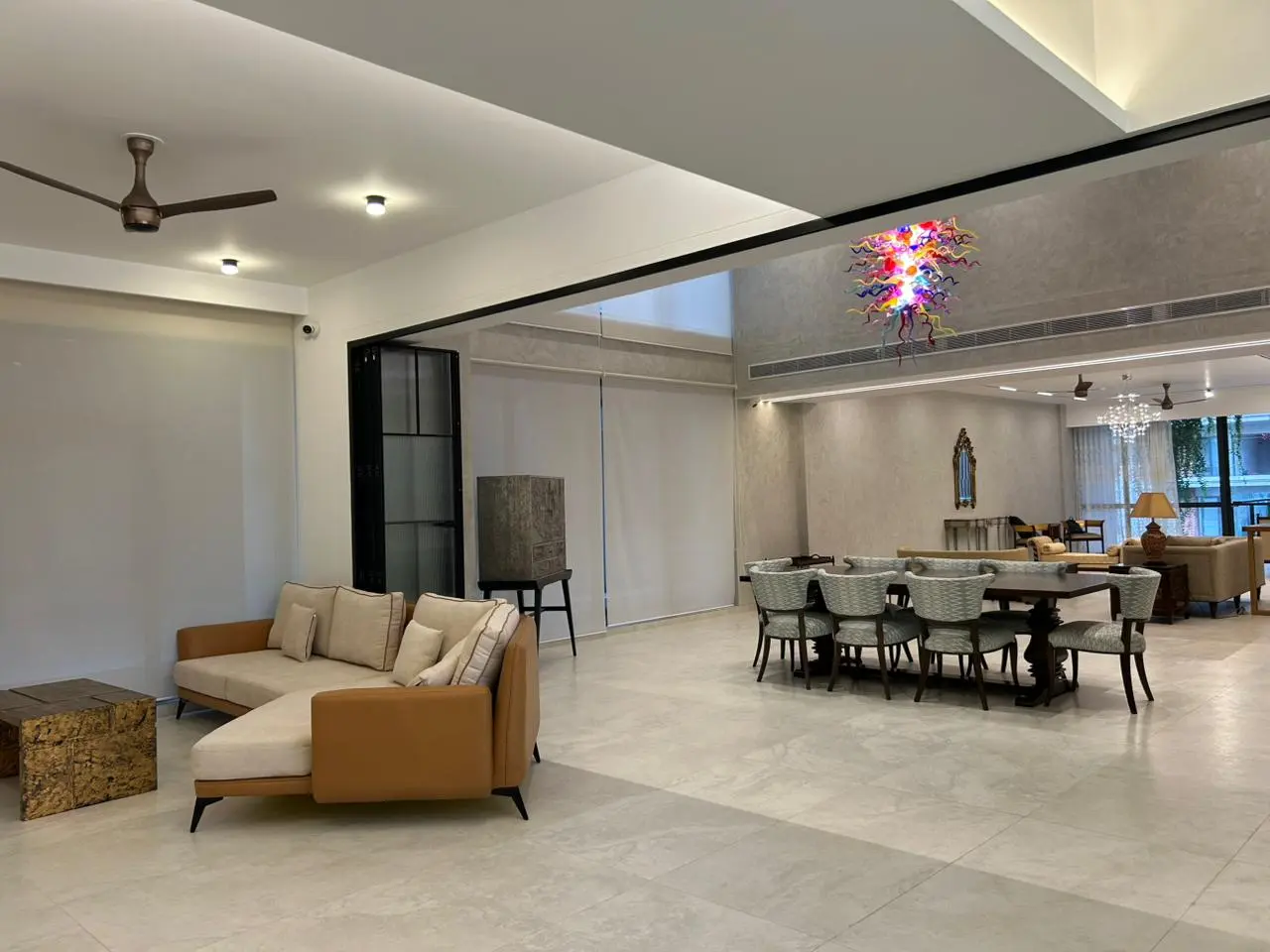
The single biggest shift in premium apartment design over the last five years has been the move toward open-plan layouts that combine living, dining, and kitchen into one continuous space. In Gulshan and Banani high-rises with 2,800 to 4,000 square feet of floor area, this approach delivers the sense of grandeur that the apartment’s address promises.
The mistake many homeowners make is confusing open with undefined. A truly successful open-plan luxury interior uses subtle architectural cues — a coffered ceiling change, a different flooring material, a partial double-sided wood screen, or a slight floor-level transition — to define zones without breaking the spatial flow. We frequently use jaali-inspired timber screens between living and dining areas, which provide visual separation while allowing light and conversation to move freely.
For apartments above 3,000 square feet, consider keeping the formal drawing room separate (Bangladeshi entertaining culture still demands it) and applying the open-plan logic to the family living, dining, and kitchen zones. This dual-zone strategy works particularly well in larger Baridhara units with multiple living areas.
Idea 2: Warm Modern Minimalism Instead of Cold Contemporary
Cold white walls, glass coffee tables, and stark black furniture defined Dhaka’s “modern” interiors for nearly a decade. They are now firmly out of fashion. The dominant aesthetic in 2026 is warm modern minimalism — clean lines and uncluttered surfaces, but anchored by warm woods, textured plaster, soft taupe and oat tones, and natural fibres.
What this looks like in practice: walls finished in lime wash or micro-cement rather than flat acrylic paint, oak or walnut joinery instead of high-gloss laminate, brushed brass or aged bronze hardware instead of chrome, and upholstery in linen, bouclé, or wool rather than synthetic blends. The palette stays restrained — cream, sand, mushroom, charcoal — but the textures do the heavy lifting.
This style suits Dhaka’s light beautifully. Our long, hot afternoons can make cold-toned interiors feel clinical. Warm minimalism softens the harshness of direct sunlight and feels considered rather than austere, even in apartments that are deliberately under-furnished.
Idea 3: Heritage-Inspired Detailing Done with Restraint
One of the most exciting developments in Bangladeshi luxury interiors is the confident reinterpretation of local craft. Jamdani textile patterns, kantha stitch geometry, jaali screens, terracotta motifs, and Mughal-era arches are showing up in premium apartments — but treated as accents, not themes.
A single feature wall in hand-painted Naskhi kantha pattern behind a bed. A pair of Jamdani-inspired pendant lamps over a dining table. A jaali timber screen between the foyer and living room. A terracotta-tiled accent in an otherwise neutral powder room. These small gestures give an apartment a sense of place — they tell visitors immediately that the home is in Dhaka, not Dubai or Singapore.
The key word here is restraint. Heritage-inspired interiors fail when they try to do too much. One or two well-placed cultural references, executed at a high level of craftsmanship, do more than a room full of mismatched traditional elements. We work with several master craftsmen in Dhaka and Sonargaon for these custom commissions, and the results are consistently the most photographed elements of every project.
Idea 4: A Statement Kitchen That Works in Bangladeshi Households
The kitchen is where most luxury interior projects in Dhaka go wrong. Imported Italian modular kitchens look stunning in showroom photos but rarely survive five years of Bangladeshi cooking — heavy spice use, deep frying, daily steam, and a domestic-help workflow that the original German layout was never designed for.
The 2026 luxury kitchen in Gulshan and Banani solves this with a hybrid approach: a beautifully detailed front-of-house kitchen for show and light cooking, and a separate utility or “wet” kitchen behind it for heavy daily cooking. The visible kitchen features handleless cabinetry in matte lacquer or natural veneer, a stone or sintered-stone island (quartzite and Dekton are leading choices), pendant lighting, and integrated premium appliances. The wet kitchen behind sits behind a sliding panel and handles the actual day-to-day cooking with stainless steel surfaces and powerful exhaust ventilation.
Material selection matters enormously. We strongly recommend BWP-grade marine plywood as the carcass material for all kitchen cabinetry, finished in matte PU lacquer or high-quality acrylic. MDF, even moisture-resistant grades, simply does not survive Dhaka humidity over a ten-year horizon. The premium up-front cost pays itself back in longevity.
Idea 5: A Master Suite That Functions as a Retreat
In a 3,500-square-foot Baridhara or Gulshan apartment, the master bedroom should not be just a bedroom. The 2026 luxury master suite is a connected sequence of spaces: a sleeping area, a walk-in dressing room, an en-suite bathroom designed like a five-star spa, and often a small lounge or reading corner.
What elevates the suite from generic to genuinely luxurious is the quality of materiality and lighting. A textured plaster or fluted timber feature wall behind the bed. Layered lighting — recessed cove lights, bedside reading sconces, low-level floor washers — controlled by a single switch panel or smart system. Heavy blackout curtains layered over sheer linen day curtains. Engineered timber flooring with underfoot warmth. A walk-in wardrobe with internal motion-sensor lighting and proper drawer organisation rather than open shelves that gather dust.
The master bathroom deserves particular attention. We are seeing strong demand for floating vanities in stone, freestanding bathtubs (where structural slab loading allows), large-format porcelain tiles that mimic natural marble at a fraction of the maintenance burden, and rainfall showers with thermostatic mixers. Brushed brass and aged bronze tap-ware have largely replaced chrome in this segment.
Idea 6: Layered, Architectural Lighting Throughout
If there is one element that separates a genuinely luxurious apartment interior from one that merely looks luxurious in photographs, it is lighting. Premium homes in 2026 abandon the single-pendant-per-room approach entirely and adopt layered lighting throughout — ambient, task, and accent layers operating independently.
In a luxury Gulshan apartment, this typically means recessed downlights for general illumination, cove and slot lighting for architectural drama, decorative pendants and chandeliers as focal points, picture lights or wall washers to highlight art, and dimmable bedside and floor lamps for evening warmth. The colour temperature should stay in the 2700K–3000K range for living and bedroom areas, with 3000K–3500K appropriate for kitchens and bathrooms.
Smart lighting control is now essentially standard at this price point. Systems from Lutron, Schneider, or comparable brands let you set scenes — “morning,” “dinner party,” “movie night” — that adjust dozens of fixtures instantly. The investment is significant but transformative; clients consistently tell us this is the single feature their guests notice first.
Idea 7: Materials That Survive Dhaka’s Climate
This is where luxury interior design in Dhaka diverges sharply from luxury interior design in Dubai, Mumbai, or Singapore. Our humidity, monsoon, dust, and termite pressure mean material choices have consequences. A beautiful interior built from the wrong materials will look exhausted within five years.
The materials that earn their place in a serious luxury apartment in 2026 include BWP-grade marine plywood for all built-in joinery, large-format porcelain tiles or natural stone for wet areas, engineered timber or porcelain wood-look planks for living areas (solid hardwood floors rarely survive Dhaka’s humidity cycles well), high-pressure laminates and PU lacquer finishes rather than melamine, anti-termite-treated timber wherever solid wood is used, moisture-resistant gypsum board for false ceilings in wet zones, and chemical waterproofing applied behind every wet wall before tiling.
Cheap board and untreated timber are responsible for the majority of complaints we hear about interiors completed by less rigorous firms. The cost difference between a kitchen built in MDF and one built in BWP marine ply is roughly 25 to 40 percent — but the ten-year durability difference is the difference between still-perfect and ready-for-replacement.
Idea 8: A Drawing Room That Reflects Bangladeshi Hospitality Culture
Despite the global move toward open-plan living, the formal drawing room remains a fixture in Dhaka’s luxury apartment culture — and rightly so. It is where guests are received, where business is sometimes conducted, and where the family signals its taste. Treating it as merely “another lounge” misreads how these homes actually function.
The 2026 luxury drawing room is more restrained than its predecessors. Instead of two heavy three-seater sofas facing each other, we increasingly design around a central focal point — a fireplace mantle (decorative, given Dhaka’s climate), a feature artwork, or a textured stone accent wall — with a more relaxed seating configuration that accommodates six to eight guests comfortably. A pair of accent chairs paired with a curved sofa and a sculptural coffee table reads more elegant than the traditional matching sofa set.
Materials that work well here: imported Italian or Turkish leather for primary upholstery, hand-knotted wool rugs (Bangladeshi or imported), brushed brass or burnished bronze accents, walnut or oak veneer console units, and a single statement chandelier or sculptural pendant. Heavy lined curtains in natural fibres complete the look.
Idea 9: Smart-Home Integration Without the Gadget Trap
Smart-home technology has matured to the point that it now belongs in any serious luxury interior project. But the goal is integration, not gadgetry — systems that disappear into the architecture, controlled through wall-mounted panels and a single app, rather than a dozen mismatched apps for a dozen devices.
The features worth integrating in a luxury Gulshan or Banani apartment include lighting control (mentioned earlier), motorised curtains and blinds, multi-zone air conditioning with smart thermostats, an integrated audio system with concealed in-ceiling speakers in main living areas, security cameras and intercom, and motion-sensor lighting in walk-in wardrobes and pantry zones. Premium clients increasingly request integration with Apple Home or Google Home as the master interface.
What we advise against: smart fridges, smart toilets, voice-controlled-everything, and any technology that requires the homeowner to learn new habits. The best smart home is one that works invisibly. If a guest cannot operate the lights without a tutorial, the design has failed.
Idea 10: A Service Wing That Actually Works
This is the idea that most international design references ignore — and the one that most affects daily life in a luxury Dhaka apartment. Households in Gulshan, Banani, and Baridhara almost universally include domestic staff: cooks, drivers, household managers, sometimes live-in help. The service wing — utility kitchen, staff bathroom, laundry, drying area, and circulation — is where many otherwise excellent interior projects fall apart.
A well-designed service wing in 2026 is properly ventilated (a quiet exhaust system rather than a noisy fan), tiled in durable large-format porcelain that cleans easily, fitted with stainless steel worktops in the wet kitchen, equipped with a dedicated washing machine and dryer alcove with proper plumbing, and gives staff their own bathroom of reasonable quality. Importantly, it is acoustically separated from the main living areas — the sound of a pressure cooker should not reach the dining table.
Designing this zone properly is what separates a firm with genuine local experience from one that is essentially translating a global template. We have seen too many imported design proposals that allocate the staff bathroom inadequate space and place the wet kitchen where its noise carries directly into the master bedroom. These mistakes are expensive to fix after handover.
Neighbourhood-Specific Considerations
The three neighbourhoods share a price tier but have meaningfully different characteristics that should influence design decisions.
Gulshan apartments tend to be in high-rises, often with smaller footprints (2,200 to 3,500 sft) and stronger views. Design here benefits from emphasising the windows — minimal window treatments, low-profile furniture along view-facing walls, and lighting layouts that work with rather than against the natural light. Privacy from neighbouring towers can be a concern; sheer day curtains paired with motorised blackouts solve this elegantly.
Banani sits closer to commercial activity and tends to mix residential, diplomatic, and corporate use within a few blocks. Apartments here are often slightly older and may need more substantial structural and MEP (mechanical, electrical, plumbing) intervention as part of any luxury renovation. Acoustic insulation is more important than in the other two neighbourhoods because of street-level traffic noise.
Baridhara, particularly the diplomatic zone, offers larger floor plates (often 3,000 to 5,000 sft) and a quieter, more residential character. Apartments here support more elaborate spatial sequences — proper foyers, formal dining rooms separate from family dining, dedicated home offices, and more generous master suites. The design language can be slightly more formal here without feeling out of place.
What a Luxury Interior Project Actually Costs in 2026
Honest numbers, since most websites avoid them. A genuinely luxury apartment interior in Gulshan, Banani, or Baridhara in 2026 typically falls between BDT 4,500 and BDT 8,500 per square foot, fully turnkey, including design fees, civil work, MEP, joinery, finishes, lighting, and all built-in elements. This excludes loose furniture, art, and soft furnishings, which can add another BDT 1,500 to BDT 4,000 per square foot depending on how heavily the space is furnished.
For a 3,000-square-foot apartment, that puts a fully realised luxury interior in the BDT 1.8 crore to BDT 3.75 crore range, with most projects landing in the middle of that band. Penthouses and very large duplex units in Baridhara can scale meaningfully beyond this. Anyone quoting significantly less than BDT 4,000 per square foot for “luxury” work is almost certainly substituting cheaper materials or skipping critical engineering steps; the result will not last.
The variables that move the number most are the percentage of imported versus locally crafted materials, the complexity of structural and ceiling work, the level of smart-home integration, and the quality tier of bathroom and kitchen fittings.
How to Choose the Right Interior Design Firm
A few markers separate firms genuinely capable of delivering luxury work from those that merely market in that direction. Look for a verifiable portfolio of completed projects in the same price tier — not just renderings, but photographed completed interiors with the firm’s name on them. Look for an in-house team of architects, interior designers, and engineers rather than a single designer outsourcing execution. Look for an in-house or closely controlled production facility, since joinery quality is the most visible element of any luxury interior. Look for a transparent, written scope and contract that itemises materials and finishes by brand and grade. And look for a track record of at least ten years — luxury interior work reveals its quality over time, and firms that have not been around long enough to see their projects age cannot demonstrate longevity.
At Concord Interior, we have operated continuously since 1994, with our own dedicated factory in Baridhara handling joinery production for every project. Our portfolio spans state buildings, leading banks, corporate headquarters, and private residences across Gulshan, Banani, Baridhara, Dhanmondi, and beyond. We collaborate with internationally recognised design and architectural partners for projects that benefit from external perspective, and we maintain in-house teams across architecture, structural design, retrofitting, interior design, landscape design, and building illumination.
Conclusion
A luxury apartment interior in Gulshan, Banani, or Baridhara is one of the most personal and significant investments a homeowner makes. Done well, it shapes how the family lives for the next fifteen to twenty years. Done badly, it is the kind of regret that gets renovated out within five.
The ten ideas above are not a stylistic prescription — they are principles that consistently produce interiors that are beautiful, functional, climate-appropriate, and durable. The right combination for your apartment depends on its size, its orientation, your family’s lifestyle, and the level of formality you want the home to project. That is the conversation worth having with a design firm before any drawings are produced.
If you are planning a luxury apartment interior project in Gulshan, Banani, Baridhara, or elsewhere in Dhaka, we would be glad to discuss how Concord Interior’s three decades of experience can shape it. Visit our portfolio to see completed work, or get in touch for a confidential consultation.
Frequently Asked Questions
How long does a luxury apartment interior project take in Gulshan or Banani? A complete luxury apartment interior project for a 3,000 sft unit typically takes 4 to 6 months from final design approval to handover. The design phase itself usually adds another 6 to 10 weeks before execution begins. Penthouses and larger duplex units can extend to 7 to 9 months.
What is the difference between an interior designer and an interior decorator for luxury projects? An interior decorator focuses on finishes, soft furnishings, and styling within an existing layout. An interior designer (or architect) handles spatial planning, structural modifications, MEP coordination, and built-in joinery in addition to finishes. Luxury apartment projects almost always require the latter.
Can existing apartments in Gulshan or Banani be fully renovated, or is this only for new units? Yes, full renovation is common and often delivers better results than first-fit work in newer developments, since the existing electrical and plumbing layout can be entirely reconfigured. Renovation projects typically run 10 to 20 percent more expensive than equivalent new-fit work due to demolition and disposal costs.
Do luxury interior projects include furniture and art? This depends on the contract scope. At Concord Interior, our standard turnkey scope includes all built-in joinery, finishes, lighting, and integrated systems. Loose furniture, art, and styling pieces are typically a separate line item, allowing clients to either commission us to source these or to procure them independently.
How do I verify the quality of a firm before signing a contract? Visit at least two of their completed projects in person if the previous owners permit. Visit their factory or production facility. Ask for material samples — actual samples, not images. Speak to at least one previous client about timeline adherence and post-handover service. Reputable firms welcome all of this.